Single desk or table.
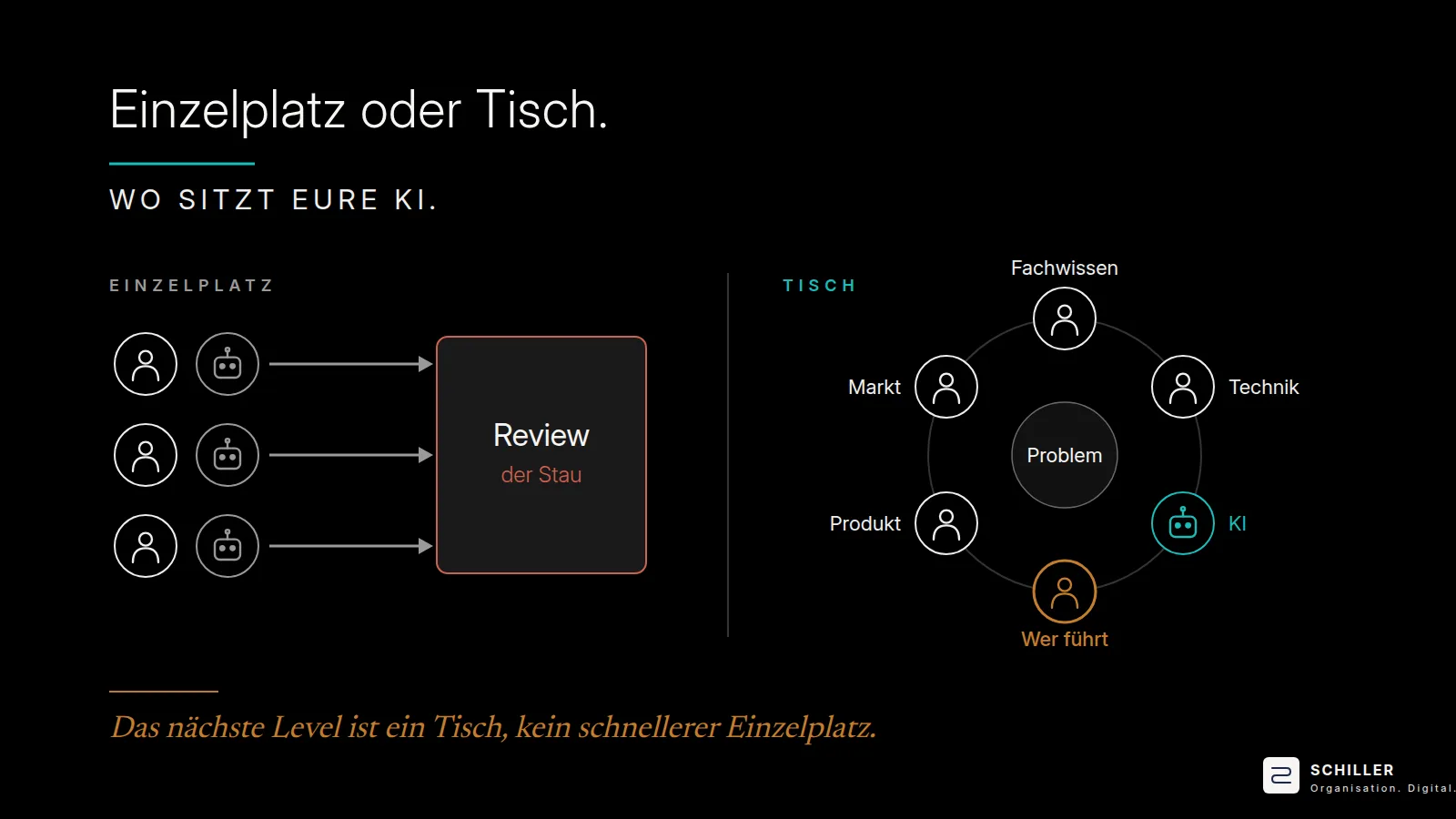
Most teams have put the AI at every single desk. Everyone writes faster, and in the end everything lands in review, where it piles up.
At the table it works the other way round. The problem sits in the middle, and everyone brings what they can, the AI too. One person leads and accepts the result.
Nobody can do everything.
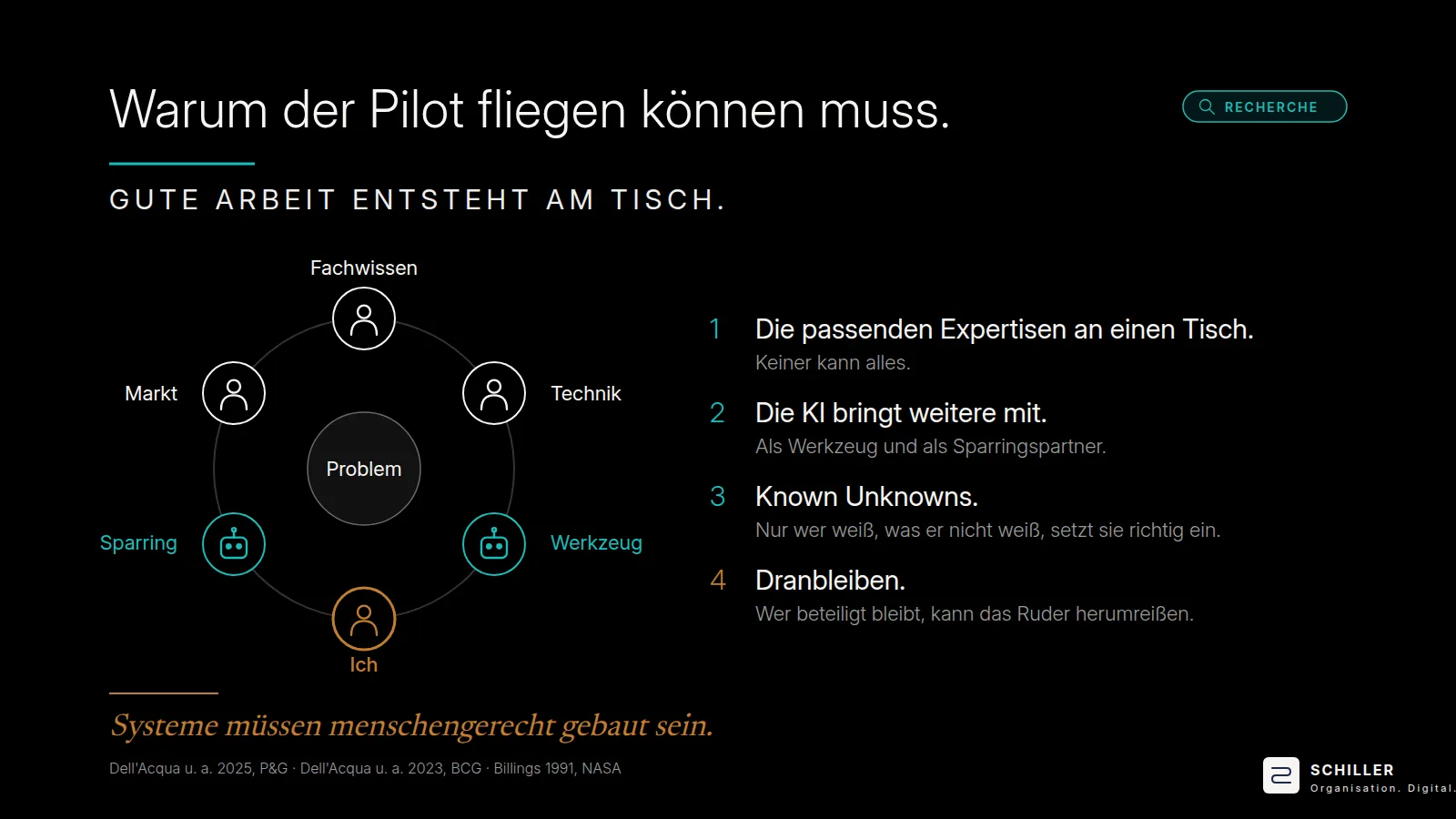
- The right expertise at one table. Nobody can do everything.
- The AI brings more of it, as a tool and as a sparring partner.
- Known unknowns. Only those who know what they don't know use it well.
- Stay involved. Whoever stays involved can turn the wheel.
In 2025 researchers tried this at Procter & Gamble with 776 professionals. Individuals with AI matched teams without AI, and solutions became more balanced, whether someone came from engineering or from sales. They measured product ideas, not software, but the table is the same.
More code, more waiting.
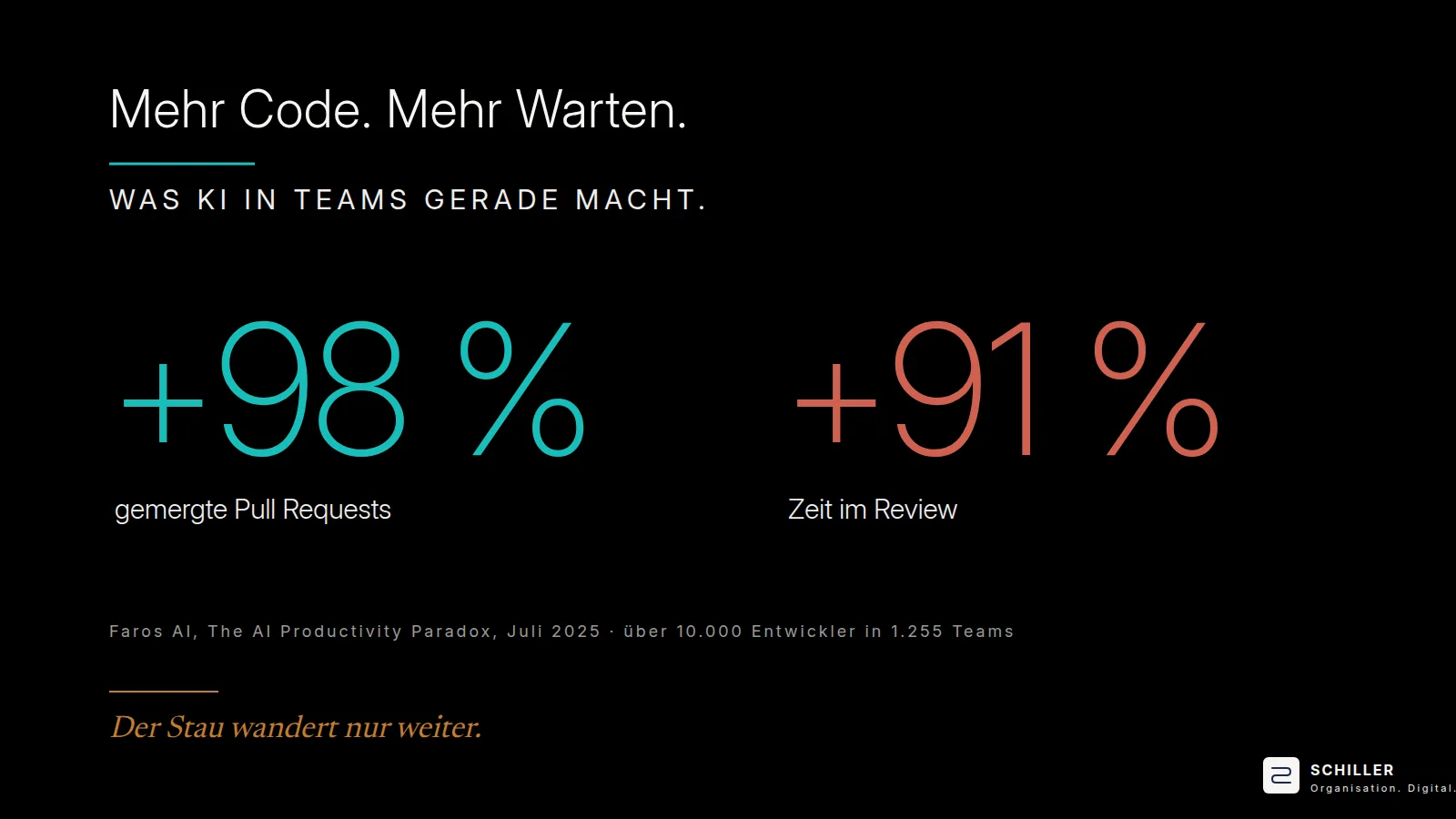
In 2025 Faros analysed tool data from more than 10,000 developers in 1,255 teams. Developers on teams with high AI adoption merge 98 percent more pull requests, and review takes 91 percent longer. Across the company they found no significant link between AI and better results.
Google's DORA study 2024 found delivery stability dropping by an estimated 7.2 percent. A year later DORA calls AI an amplifier, of the strengths of good teams and of the weaknesses of the others.
„AI’s primary role in software development is that of an amplifier.“
The human leads.
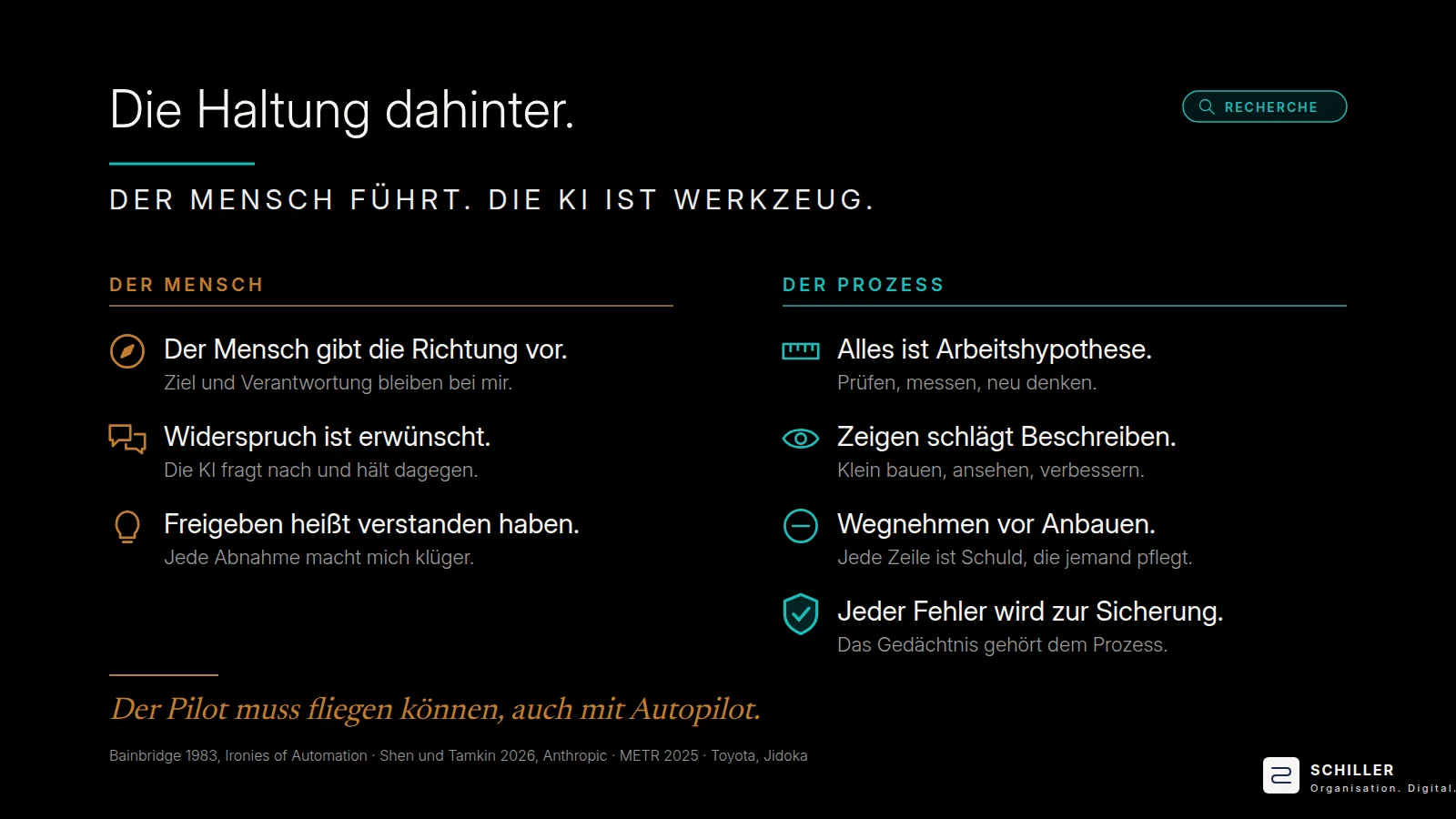
The AI is fast, confident and forgets everything after each session. That is why a person leads at the table who knows what they approve, and the process makes sure every mistake happens only once. The pilot must be able to fly, even with autopilot.
One day, exactly like this.
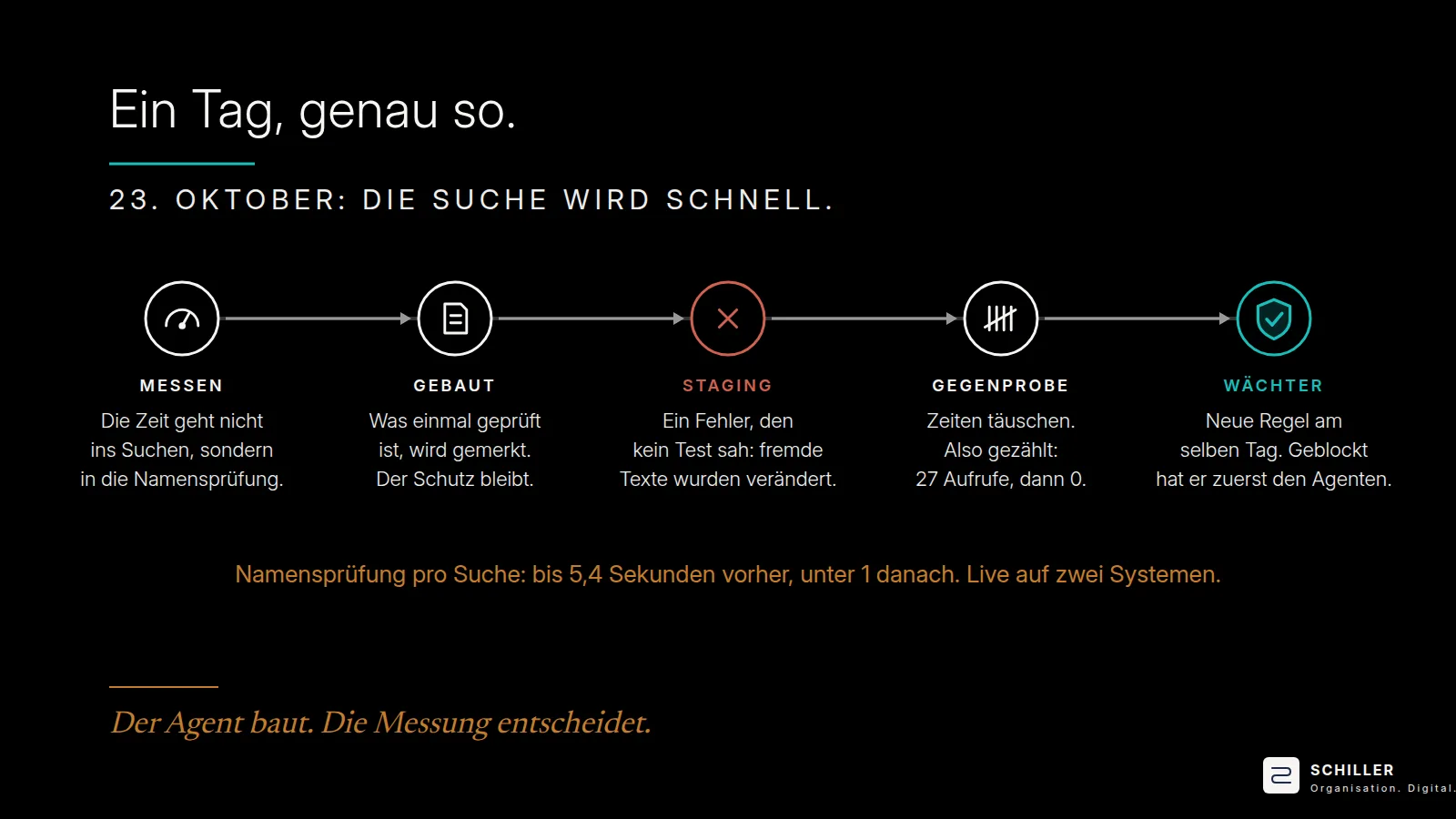
On 23 October my knowledge search was meant to get faster. We measured first, and the time was going somewhere else entirely. On the test environment a bug showed up that no test had seen. In the end name checking per search took less than one second instead of up to 5.4. The AI built it, the measurement decided.
This is how I work every day. In the 30 days up to 26 October 2026 that was 3,038 commits, 99 percent of them with the AI as co-author.
What we do
Three things that belong together.
The table
Who sits there, who leads, who decides
Sound familiar?
Engineering builds what the ticket says. The business side only notices at acceptance that it does not fit, and the market never shows up in the project. Everyone is fast, just not together.
What we do
We put the problem in the middle and bring in whoever can solve it, from engineering, the business side, product and market. We clarify who approves the spec and who accepts the result. And we keep the rounds small enough to fit into everyday work.
The AI at the table
As a tool and as a sparring partner
Sound familiar?
The rules live in a wiki the AI never reads. The agent writes tests that fit its own code and are therefore always green. And the same mistake happens for the third time.
What we do
We put the rules where the agent reads them at start, and let it disagree before it builds. What really matters becomes mechanical, as a test, a hook or a check before deploy. Every mistake may happen once, then it becomes a rule.
Staying involved
Learning, measuring and keeping the wheel in hand
Sound familiar?
Since the AI writes along, nobody quite knows who actually decides. The experienced people review into the evening, the newcomers let it write and understand less and less of it. And at some point someone in review just says yes, because it is green anyway.
What we do
We measure before we build and check again before we believe anything. Everyone who approves must understand what they approve, the newcomers first. The pilot must be able to fly, even with autopilot.
Who I work with
- You build software and already use AI or want to. I start where it gets stuck.
- You want to change something, not just buy a tool. Roles, routines and attitude are part of it.
- You take part yourselves. I bring the outside view, but the table belongs to you.

Michael Schiller
I led IT and software development, worked as product owner and as agile coach for a development unit. Today I build software myself, with AI.
How it starts
Talk for 30 minutes
FreeYou tell me how you work with AI and where it gets stuck. I tell you whether I can help.
One day at the table
Where you standWith your team and the people from the business side and product. Afterwards you know where the table is missing and what comes first.
Build the table
In small stepsOn real tasks. After each step we look at what holds and what can go again, and you decide whether to continue.
Frequently asked questions
-
Do you sell a tool or a framework?No. Afterwards the guard rails live as files, tests and scripts in your repository and belong to you. I work with Claude Code myself.
-
Do people outside engineering need to take part?Yes, ideally. A table with only developers is a single desk with more chairs. The business side, product or sales belong there, at least for the spec and for acceptance.
-
We barely use AI yet. Is it too early?No, it is rather a good moment. Teams that have tests, small steps and clear rules beforehand get more speed and less chaos from AI. The rule “clean up first, then AI” holds in the repository too.
-
Do you code yourself?Yes, every day, with AI. I build my own platform with Ruby on Rails, almost all of it written by the AI and taken through a process with tests, guards and staging. Before that I led development teams.
-
You work alone. What do you know about teams?My repository is a lab with one person. What I lack are pull requests with a person who reads along. I know teams from many years as head of IT, product owner and agile coach, and I bring both together.
-
What does it cost?We discuss that in the first conversation, depending on scope. The conversation itself costs nothing.
